Predictive Structure Under Extreme Ambiguity
Can reproducible predictive structure exist inside highly stochastic and short biological trajectories?
Classification Summary
Short observation windows
State switching
Diffusion mixtures
Strong overlap
High stochasticity
Key Insight
High stochasticity does not automatically imply predictive impossibility.
Question
To investigate this question, the Predictive Feasibility Assessment framework was applied to real-world fastSPT biological trajectory data.
These systems represent one of the most challenging environments tested so far.
- Short observation windows
- State switching
- Diffusion mixtures
- Strong overlap
- High stochasticity
At first glance, stable prediction appears unlikely.
What Was Evaluated?
The analysis focused on:
- Entropy
- Overlap ambiguity
- Persistence
- Inferability structure
- Forecasting behavior
- Cross-run reproducibility
Result
Despite extreme stochastic behavior, substantial predictive structure remained visible.
The majority of trajectories remained inside stable or partially stable predictive regimes.
This was observed across:
- Independent runs
- Independent cells
- Different biological conditions
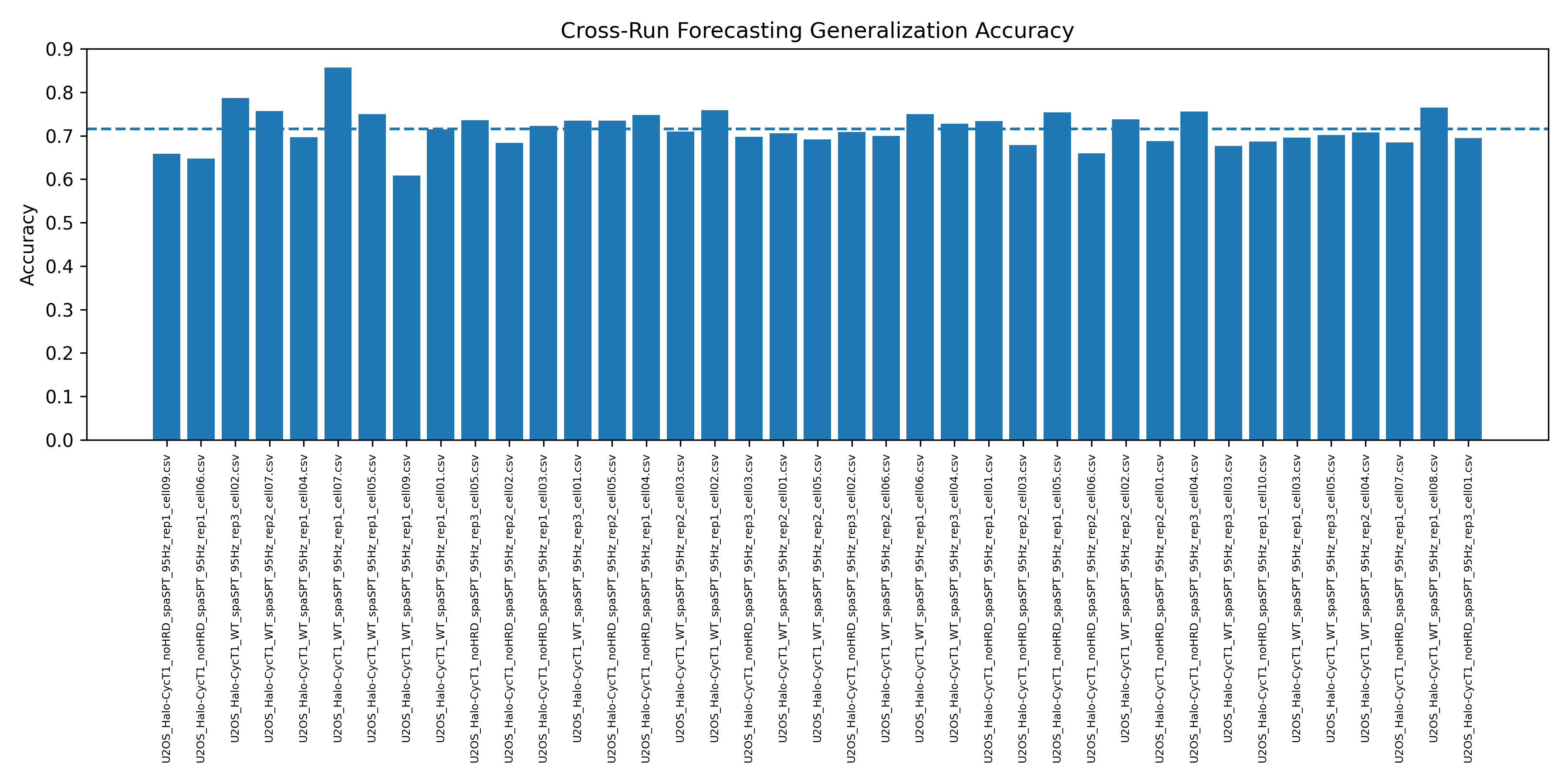
Figure 1 — Predictive Structure in fastSPT Trajectories
Predictive feasibility within biological fastSPT diffusion trajectories.
Despite short trajectories, state switching, overlap ambiguity, and strong stochastic variation, reproducible structure remains detectable across multiple conditions.
The figure demonstrates that predictive feasibility is not restricted to slow degradation systems and may also emerge within highly dynamic biological environments.
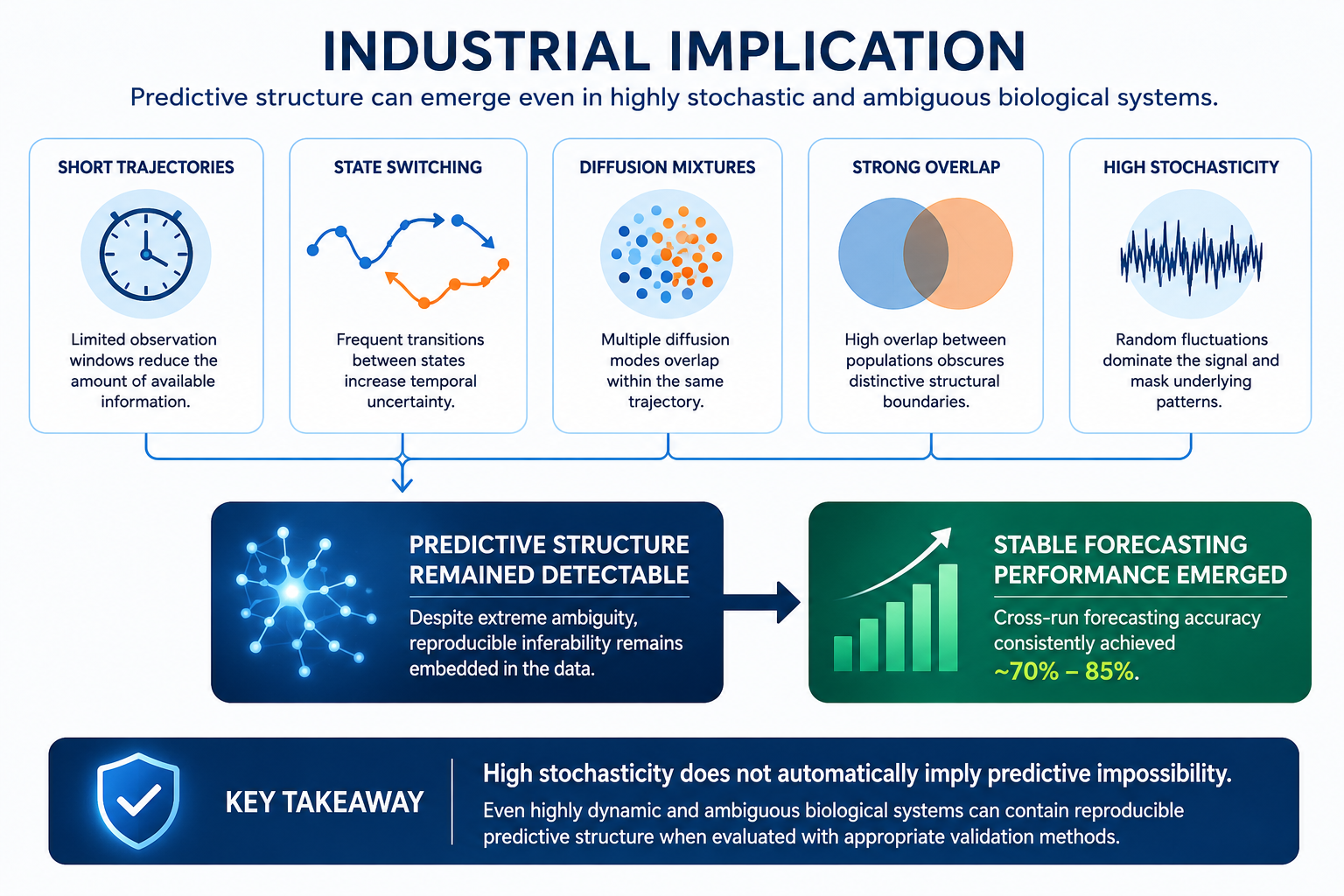
Industrial Implication
Predictive structure can emerge even in highly stochastic and ambiguous biological systems.
Despite short trajectories, state switching, diffusion mixtures, overlap ambiguity, and strong stochasticity, reproducible inferability remains detectable.
Stable forecasting performance can emerge when appropriate validation methods are applied.
Why This Matters
Many predictive frameworks perform well only in slow and highly structured systems.
This validation demonstrates that predictive feasibility concepts can remain meaningful even under extreme uncertainty.
Key Takeaway
High stochasticity does not automatically imply predictive impossibility.
Even highly dynamic systems can contain reproducible predictive structure when evaluated using appropriate validation methods.