A low-risk first step before large-scale predictive AI development.
A Pilot Assessment evaluates whether existing operational data contains stable, reproducible predictive structure before major model-development or deployment investment begins.
The purpose is to reduce uncertainty early: before months of feature engineering, model tuning, retraining cycles, and deployment preparation are invested in a signal that may not structurally support reliable prediction.
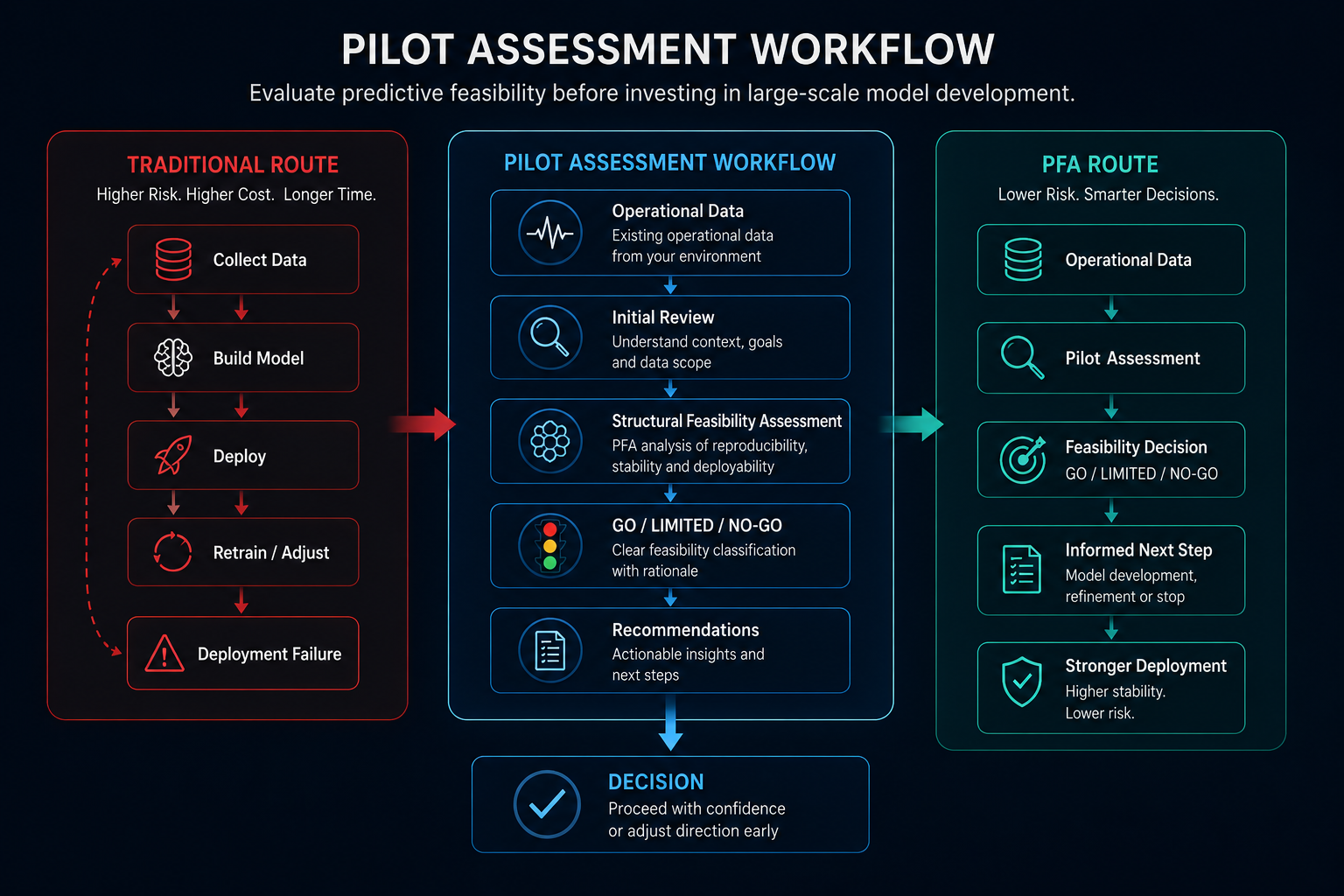
Pilot Assessment Workflow
Many predictive AI projects begin by collecting data, engineering features, building models, deploying, and then retraining when instability appears. PFA introduces a decision layer before large-scale modeling begins.
What a Pilot Delivers
A Pilot Assessment is designed to produce practical decision-making clarity. The objective is not only to classify a signal, but to explain the reason behind the classification and identify possible next steps.
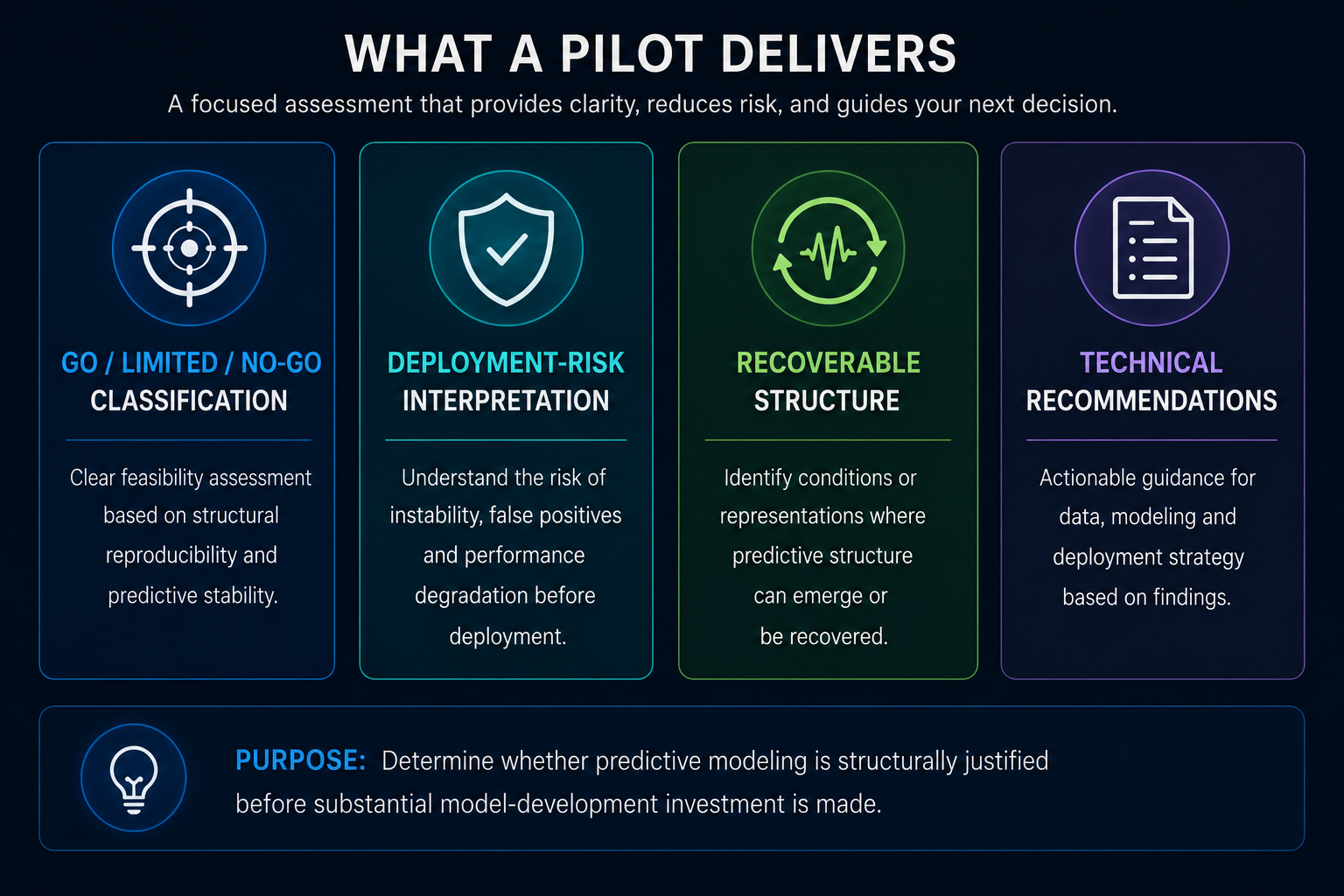
Decision clarity
GO, LIMITED, or NO-GO classification with deployment-risk interpretation.
Technical direction
Identification of limiting factors, recoverable structure, and practical recommendations.
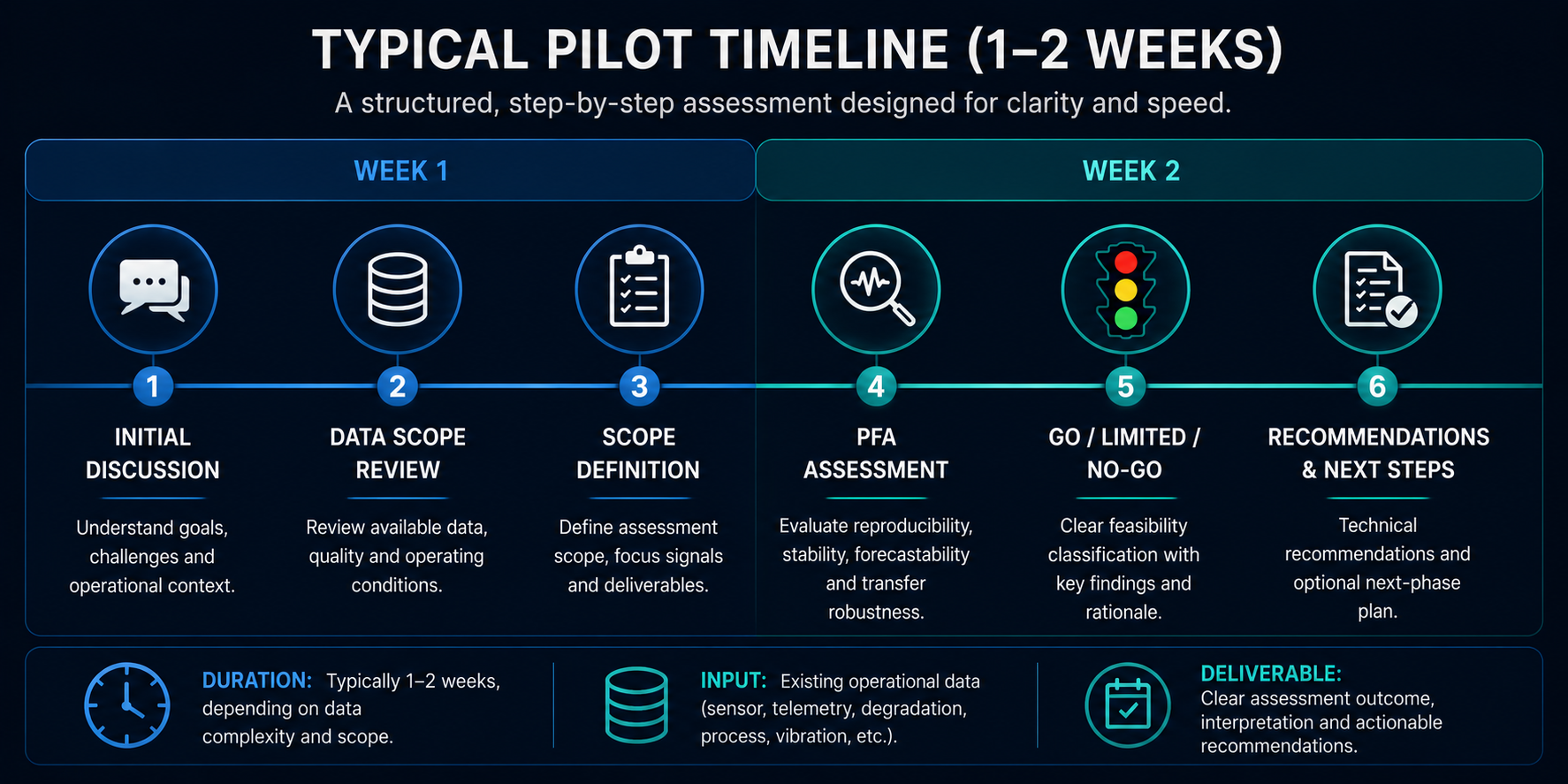
Typical Pilot Timeline
Unlike large predictive-AI programs that may run for months, a Pilot Assessment is intentionally short and focused. The typical purpose is to answer one fundamental question quickly: is further predictive-model development justified?
Example Pilot Outcome
A Pilot Assessment does not merely reject signals. In many cases, it can reveal whether predictive structure is recoverable through better representation, segmentation, operating-regime separation, or improved feature focus.
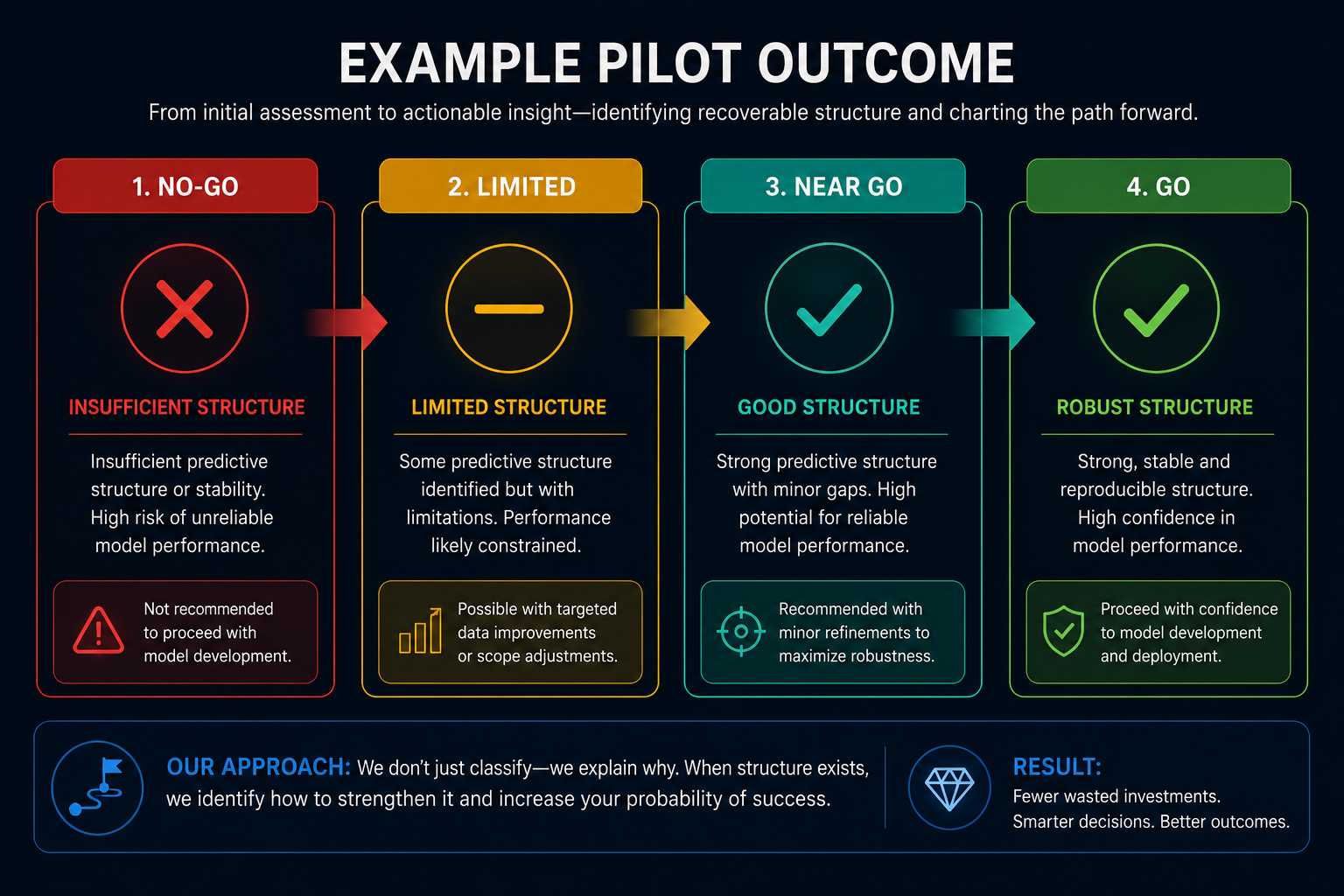
The goal is to identify pathways toward more stable and reliable prediction whenever recoverable structure exists.
Reducing wasted cost and wasted time
Organizations often focus on the direct cost of model development. Equally important is the cost of time. Months spent developing unstable predictive models can delay operational improvements, consume engineering capacity, and reduce project momentum.
A Pilot Assessment helps identify high-risk signals early, avoid prolonged retraining cycles, and accelerate the path toward reliable deployment. In many industrial environments, avoiding months of wasted engineering time can be as valuable as the direct financial savings themselves.
Request a Pilot Assessment
Start with a low-risk review of your use case. Operational data does not need to be uploaded at the first contact stage.
Request Assessment →