A Predictive Feasibility Assessment does not start by asking which model performs best. It first asks whether the signal contains enough stable, reproducible structure to justify predictive modeling at all.
GO, LIMITED, and NO-GO are not model scores. They are deployment-readiness indications based on whether predictive structure remains reproducible across runs, regimes, and operating conditions.
The signal shows reproducible structure across runs or operating conditions. Model development is structurally justified, although normal validation is still required.
Some useful structure may exist, but stability depends on representation, operating regime, filtering, or additional observability. Modeling may be possible, but risk is elevated.
The signal may contain activity, but not stable predictive structure. Continuing directly into modeling may create retraining loops, false positives, and deployment instability.
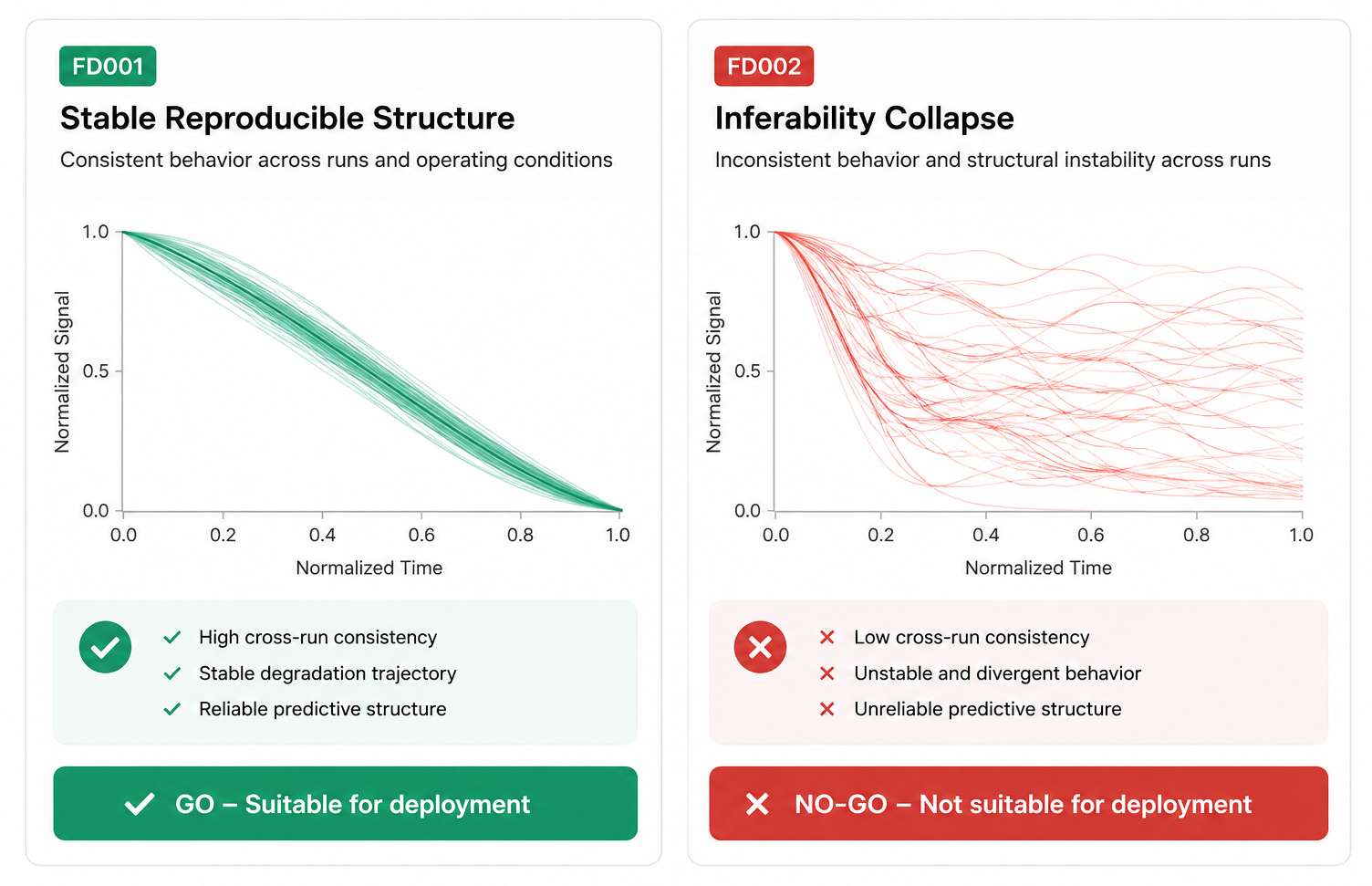
FD001 behaves as a GO-like predictive regime because its structure remains comparatively stable. FD002 behaves as a NO-GO-like regime because visible signal activity does not translate into reliable predictive structure.
The purpose of this comparison is not to prove that one model is better than another. It shows that predictive feasibility depends on whether the underlying signal structure remains reproducible enough to support stable deployment.
The PFA decision layer is designed to evaluate predictive feasibility across different signal classes, including vibration systems, battery degradation, turbofan degradation, and scientific trajectory data.
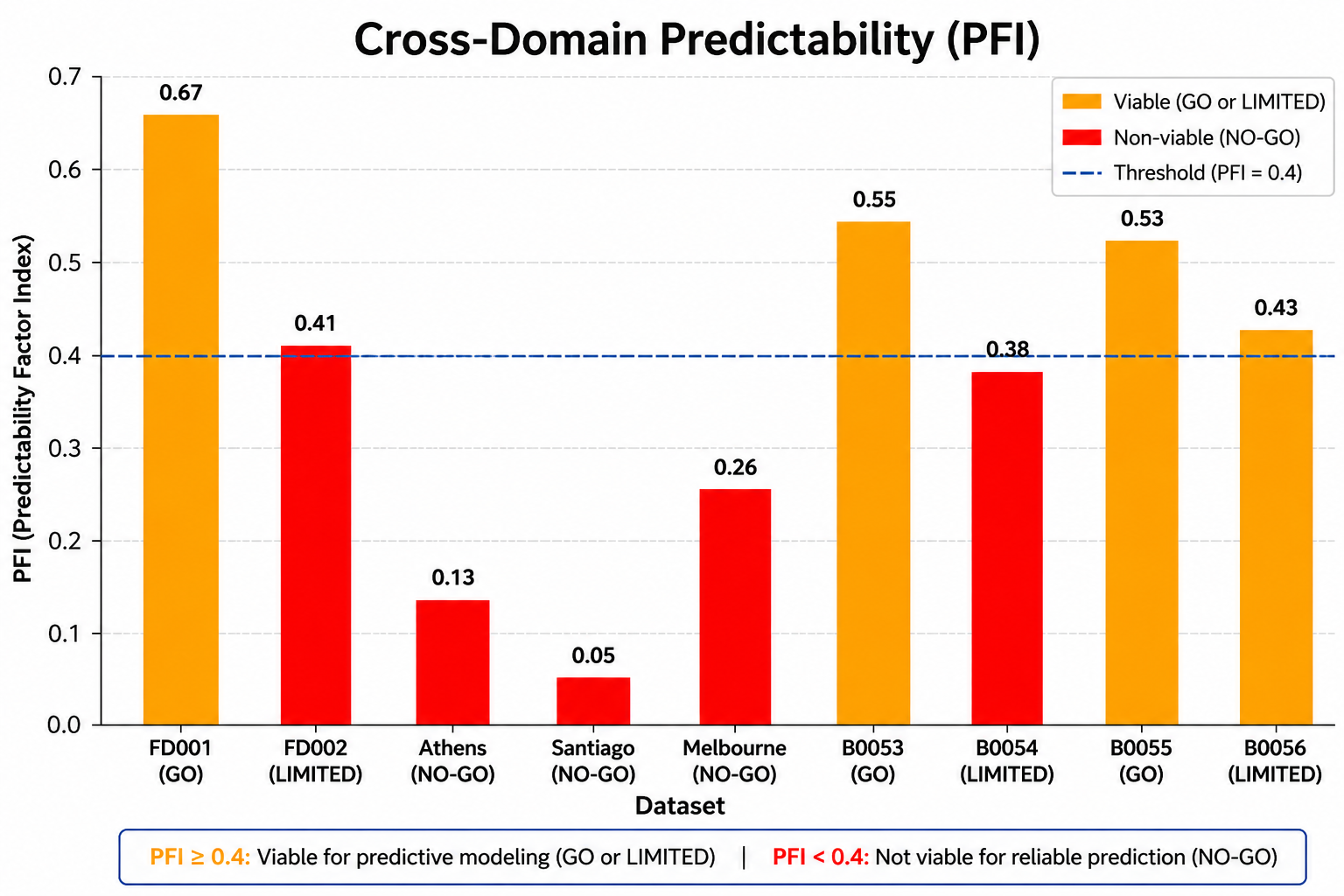
The Predictive Feasibility Index summarizes whether signals fall into GO, LIMITED, or NO-GO regions. This helps separate signals that can support reliable modeling from signals where deployment risk remains structurally high.
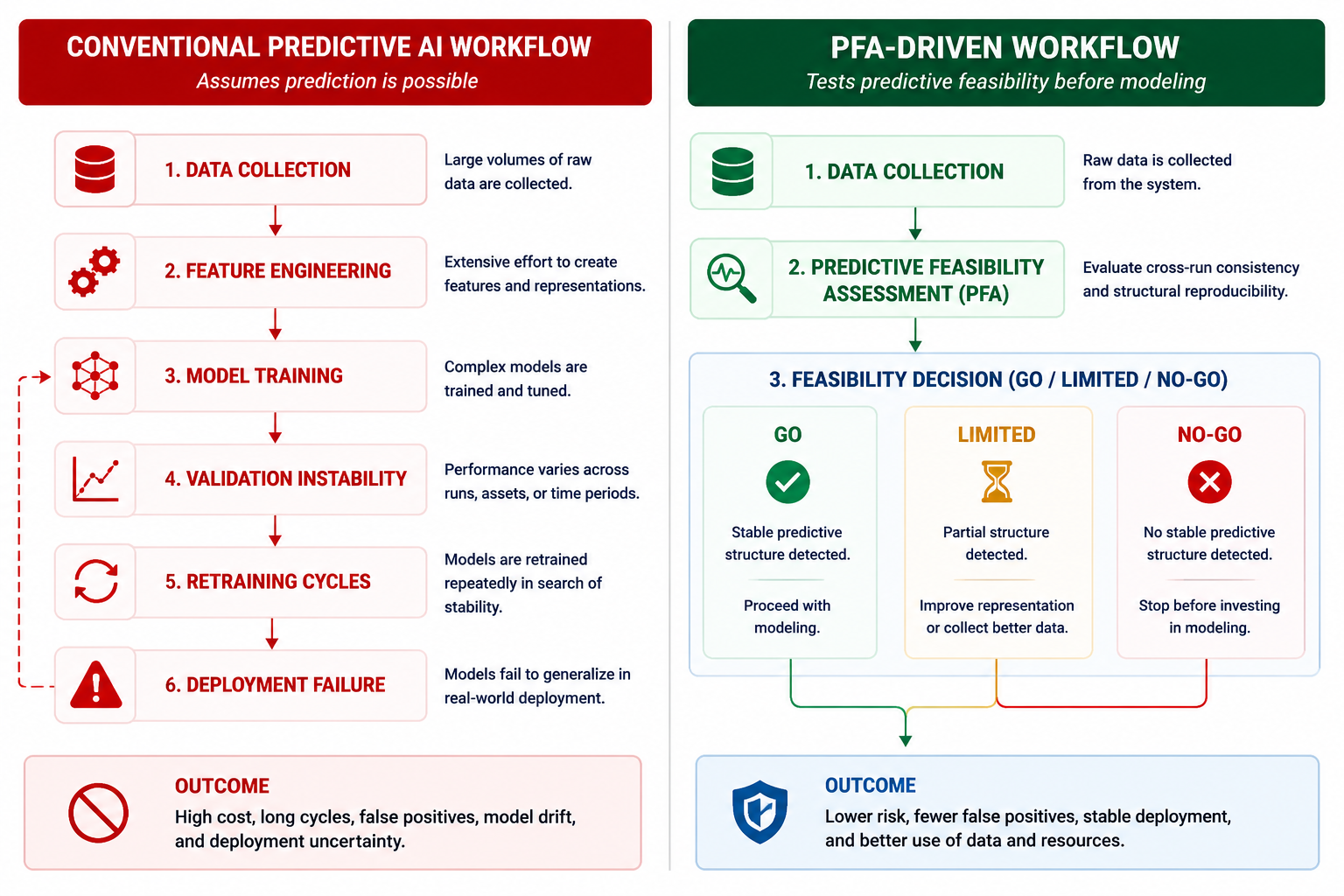
Without a feasibility decision layer, teams often move directly from data collection to feature engineering, model training, retraining, and deployment failure. PFA changes the sequence by testing predictive feasibility first.
Conventional predictive AI workflows often assume that prediction is possible. The PFA-driven workflow tests whether prediction is structurally justified before large-scale modeling begins.
A focused PFA scan can evaluate whether your data supports GO, LIMITED, or NO-GO predictive feasibility before further deployment investment.