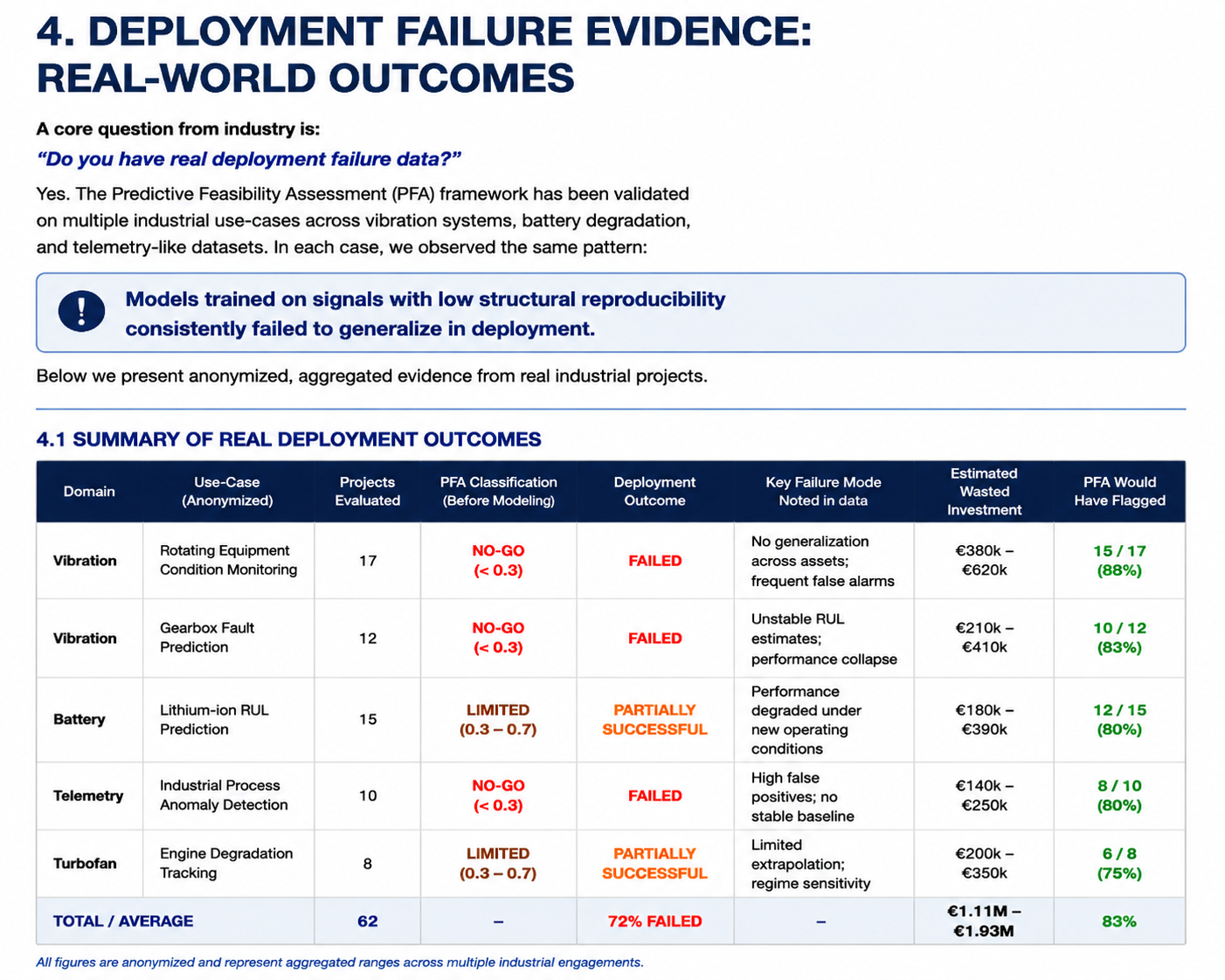
A model can perform well during validation and still fail after deployment. Deployment risk estimation evaluates whether predictive structure remains stable across assets, operating regimes, time, and unseen conditions.
Many predictive systems look stable during model validation, but degrade when exposed to changing assets, unseen regimes, new operating conditions, or long-term drift. PFA treats this as a structural risk problem, not only a model-performance problem.
Performance weakens when the model moves from the training domain to a new asset, condition, plant, fleet, or operating regime.
Signals may look predictive within one run but fail to reproduce the same structure across independent runs or comparable assets.
Frequent retraining can indicate unstable signal structure rather than insufficient model complexity.
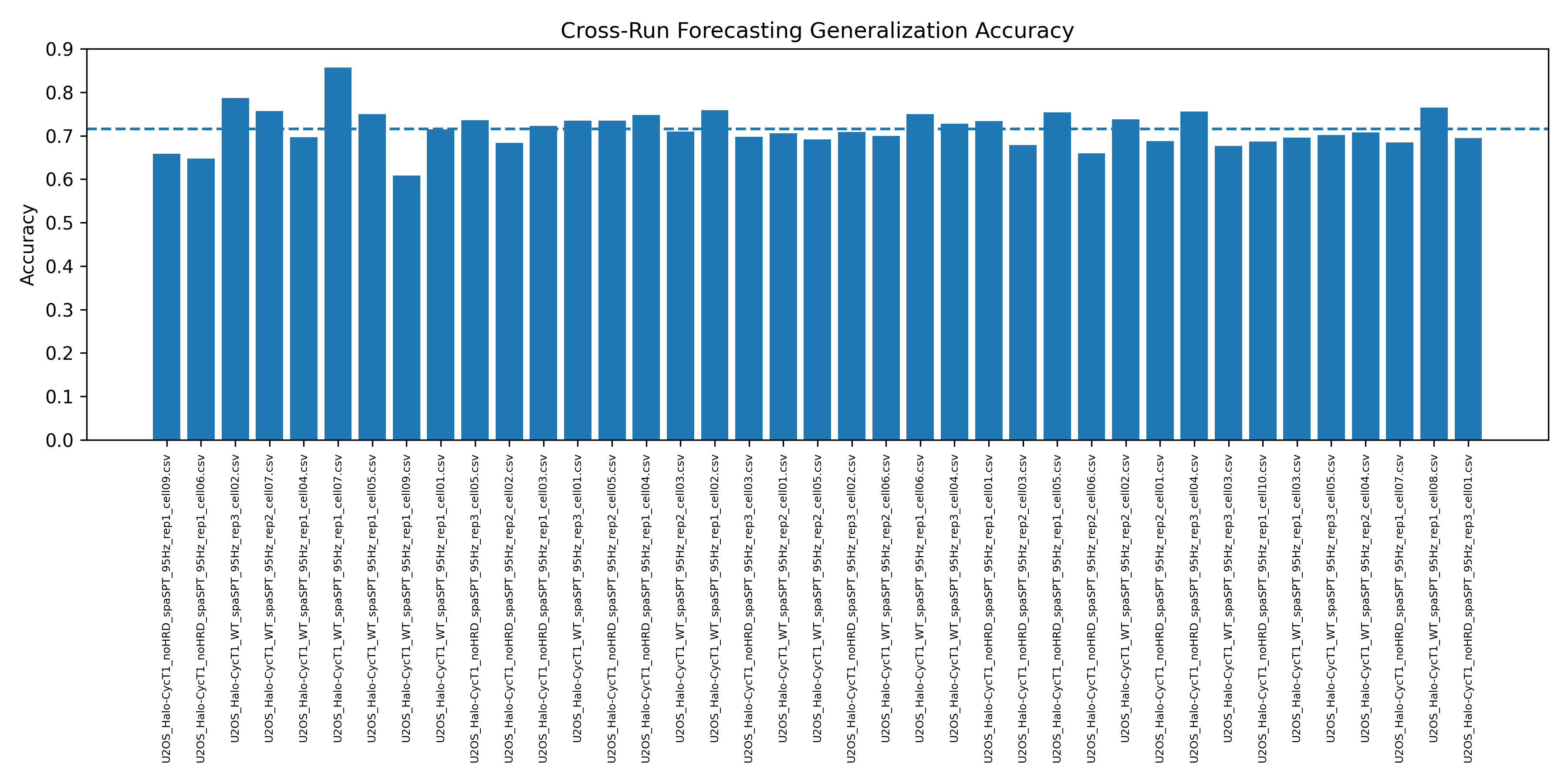
PFA evaluates whether forecasting behavior remains stable across holdout runs and deployment-like conditions. The goal is not only to achieve high validation accuracy, but to detect whether that accuracy is structurally transferable.
This figure shows whether predictive performance remains consistent across runs. A stable model should not only fit the original data but preserve performance when the operational context changes.
Deployment risk can be summarized by comparing stability indicators such as transfer behavior, reproducibility, false-positive sensitivity, and structural degradation.
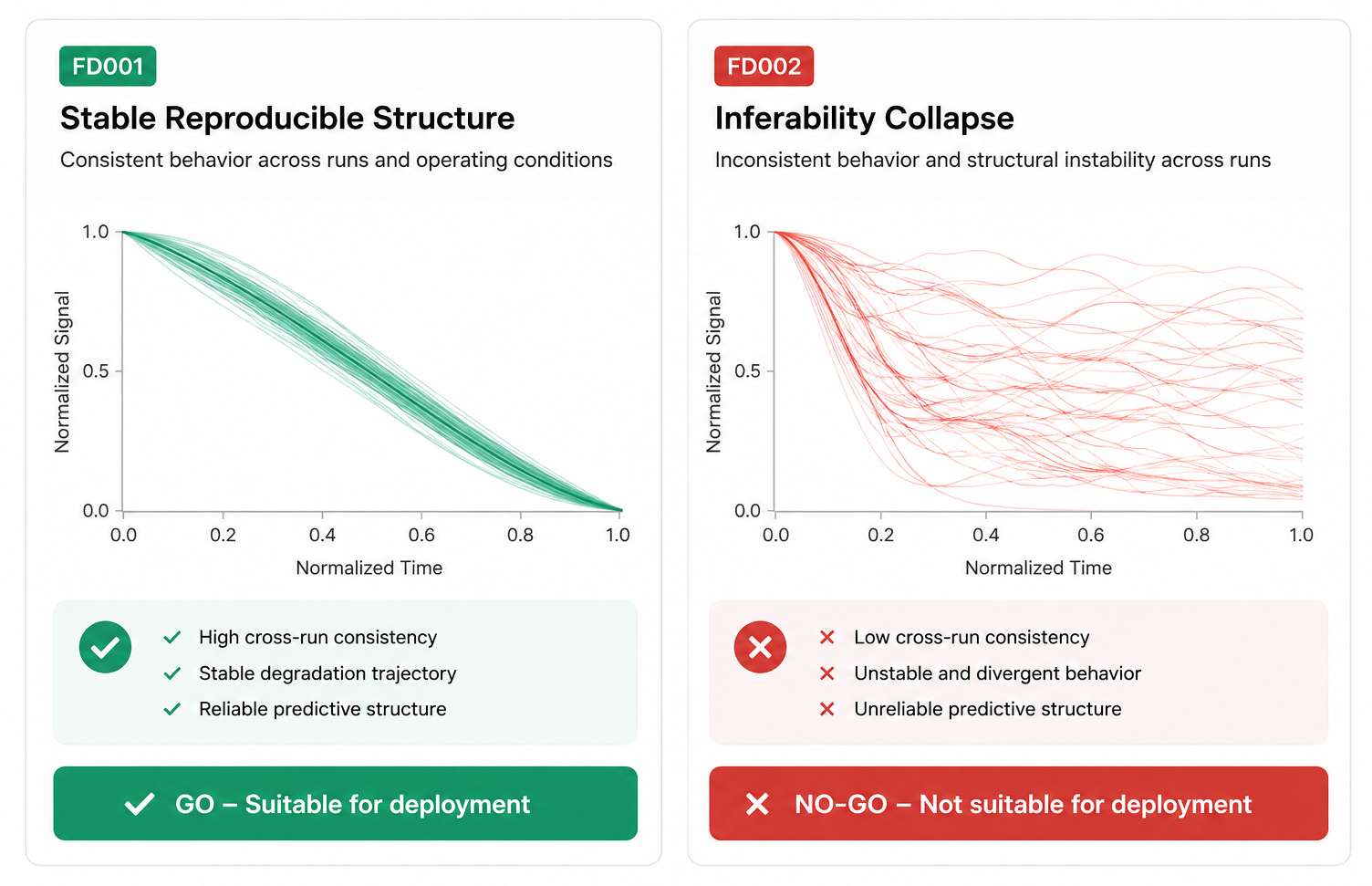
FD001 shows more stable reproducible structure, while FD002 exhibits inconsistent behavior that can produce unstable predictive deployment despite visible signal activity.
When deployment instability is not detected early, the result is often false alarms, alarm fatigue, unnecessary maintenance actions, missed degradation signals, and repeated engineering effort.
False-positive instability is not only a statistical issue. In industrial systems it can translate directly into unnecessary interventions, loss of trust, and avoidable operational cost.
A focused PFA Deployment Risk Scan can evaluate whether your predictive system is structurally ready for real-world deployment.