Transfer stability evaluates whether predictive structure remains usable when conditions change: new assets, new regimes, new runs, new fleets, or unseen deployment environments.
A model can perform well on one dataset, one asset, or one operating condition while failing when transferred to another. PFA treats this as a structural deployment-risk problem rather than only a model-tuning problem.
Prediction may fail when the model is applied to another machine, battery, fleet, sensor, or operational unit.
Signals can behave differently under changed operating regimes, loads, environmental states, or degradation phases.
A signal may be locally predictable while failing to reproduce the same predictive structure across independent runs.
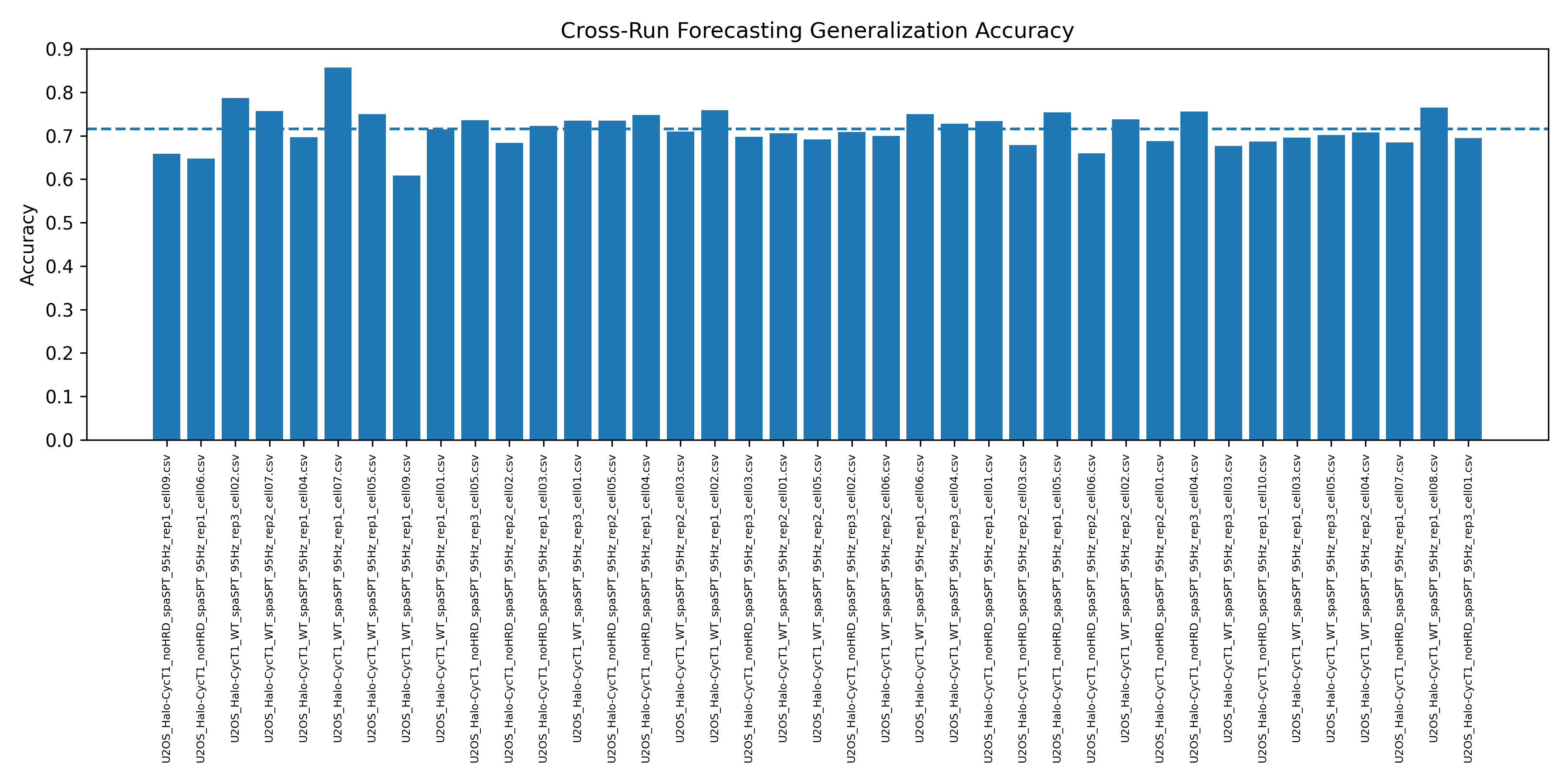
Transfer stability requires more than fitting the observed data. It requires that forecasting behavior remains stable when evaluated on unseen or deployment-like conditions.
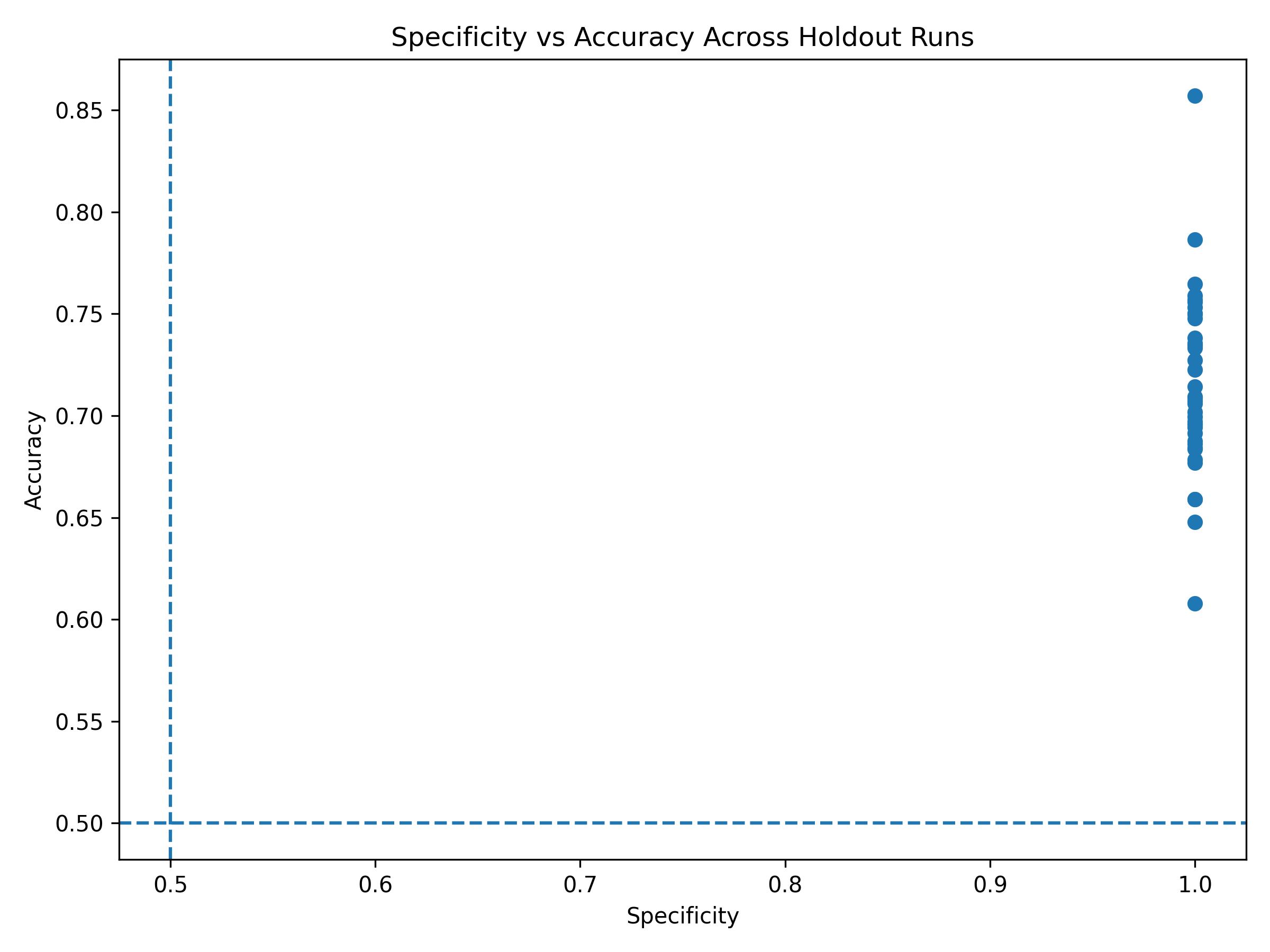
This figure evaluates whether forecasting behavior remains reliable across holdout runs. A system that cannot generalize across runs may produce unstable deployment behavior even when validation results look acceptable.
A predictive system should not only detect events; it should remain specific enough to avoid unstable warning behavior under changing conditions.
This validation layer checks whether the system can preserve useful deployment behavior without producing excessive false alarms or unstable predictions under transfer.
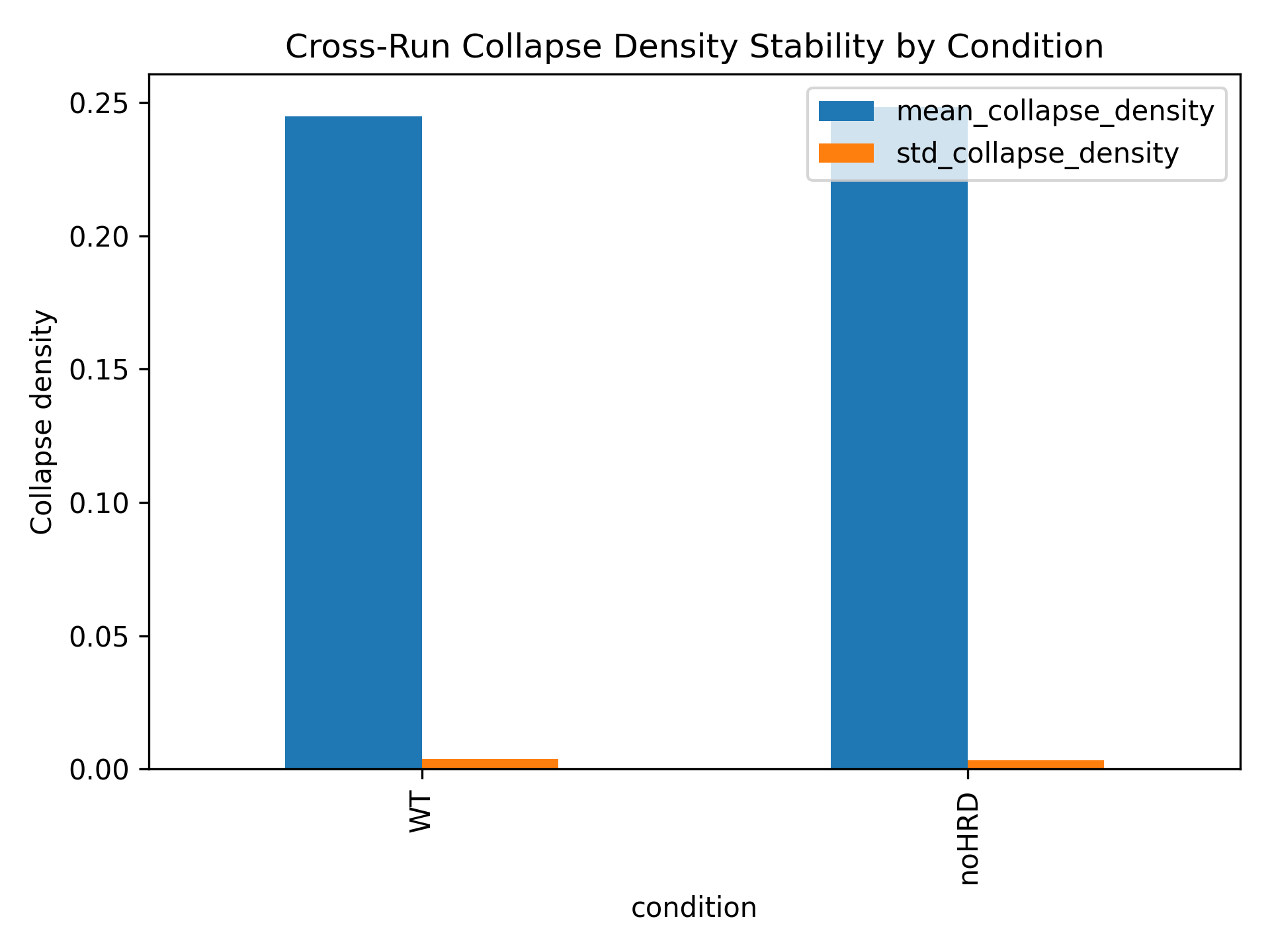
Transfer stability improves when collapse-related or instability-related structure remains reproducible across independent runs.
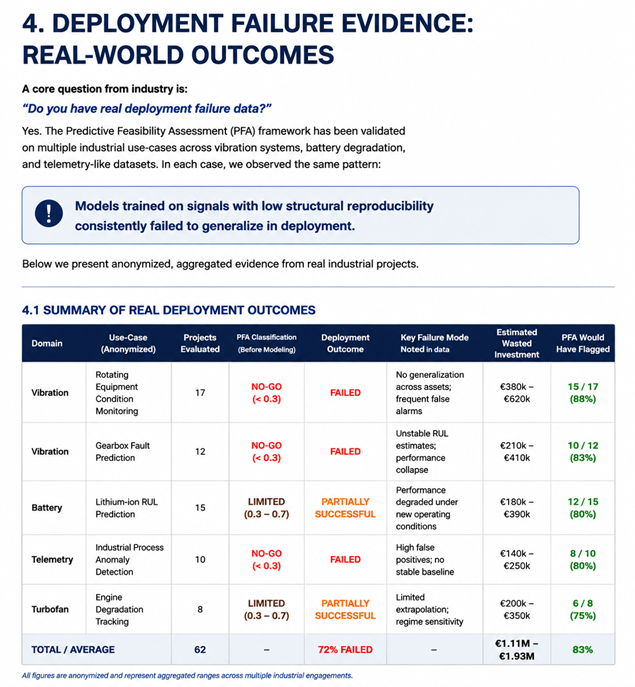
Deployment risk can be summarized through indicators such as transfer behavior, reproducibility, false-positive sensitivity, and stability degradation.
A model that performs well only under the original training condition may not be operationally useful. PFA estimates whether predictive structure survives the shift from experimental validation to real deployment.
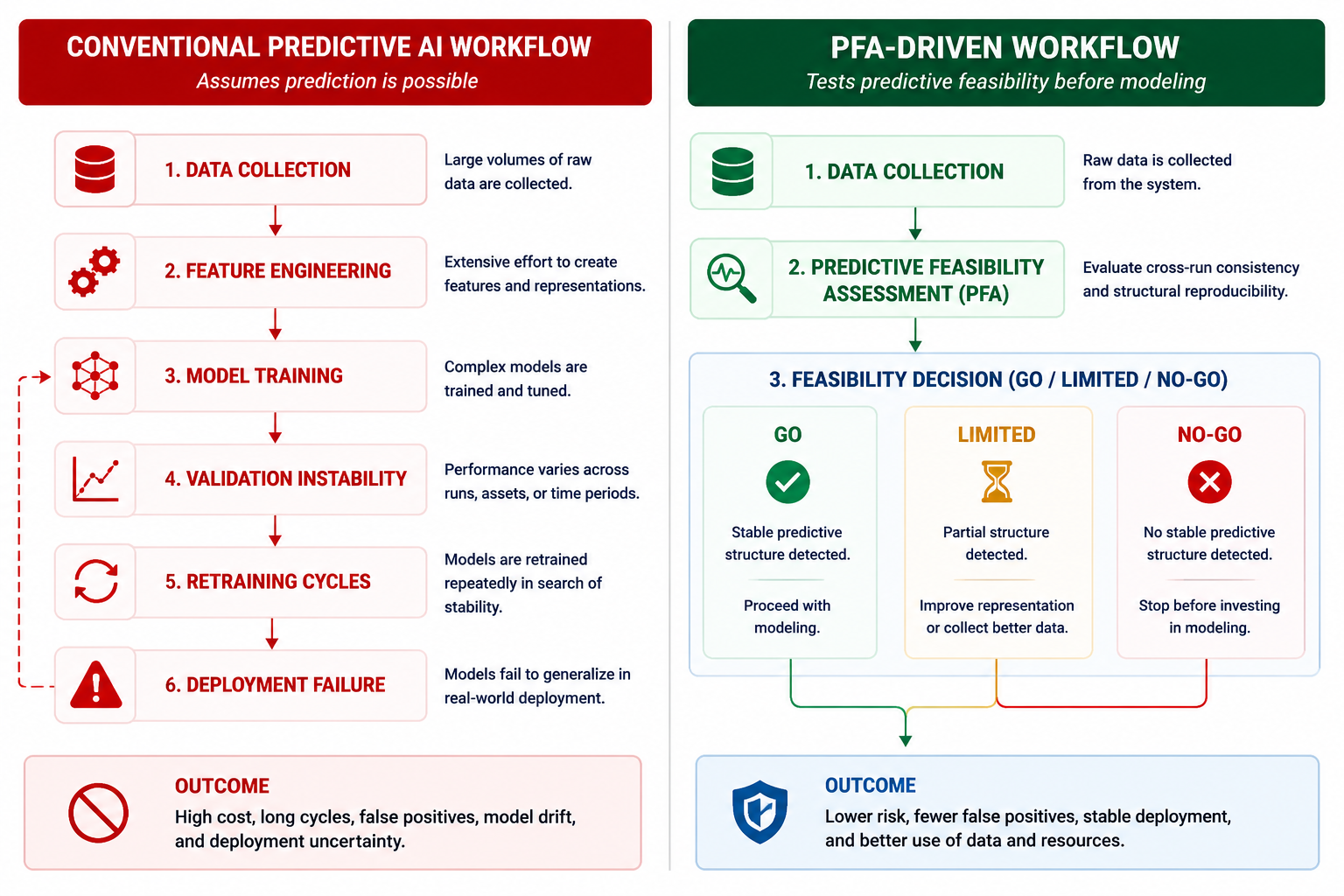
The conventional workflow often discovers transfer failure after deployment. PFA places transfer-stability assessment before large-scale model development, reducing the risk of retraining loops and unstable deployment behavior.
A focused PFA scan can evaluate whether your predictive system is likely to remain stable across assets, conditions, and deployment environments.